

Welcome to The AMR Global Health Academy Newsletter
September 2025
The AMR Global Health Academy serves the global health professional and antimicrobial steward in low- and middle-income countries with a free online educational curriculum designed to advance AMR knowledge and best practices. Every month, via the Newsletter, we share important updates from the AMR field, especially as it relates to AMR testing, diagnostics, and surveillance. We feature news stories, articles, events, resources, and AMR champions battling the real-world AMR problems.
The AMR Academy has numerous courses and educational activities designed to empower AMR stewards, particularly global health professionals from LMICs. Check out this year’s AMR Problem Solving Case Study series where we are focusing on community engagement to drive action against AMR. (Materials available in English, French, Portuguese and Spanish.)
To join the AMR Global Health Academy, enroll in the Global Health Continuing Professional Development (GHCPD) free online AMR courses here.
AMR Global Health Academy Champions
In our previous newsletter, we introduced the new Training of Trainers (TOT) initiative, designed to enhance capacity in healthcare education and cultivate educational leadership in collaboration with Somaliland. In this edition, we are pleased to feature two participants from the program and share their perspectives on this important initiative.

“The CPD courses from GHCPD/GHIG have opened new horizons for my professional growth. They not only will enhance my understanding of antimicrobial resistance but also will equip me with skills that will shape my future work in protecting public health in Somaliland.”
– Rahma Yasin, Borama Regional Hospital

“This program is especially interesting to me because it offers a unique opportunity to enhance my professional skills and contribute more effectively to the healthcare sector in Somaliland. With my background in public health, field experience in community health, and commitment to continuous learning, the focus on Antimicrobial Resistance (AMR) and Continuous Professional Development (CPD) aligns perfectly with my career goals. The Training of Trainers approach will allow me not only to strengthen my own knowledge but also to share it with colleagues and communities, improving healthcare practices and outcomes. The use of accredited courses and digital platforms makes it even more appealing, as it ensures quality learning and wider access.”
– Abdillahi Mohomed, Borama Regional Hospital
News Story
The Impact of Treating STIs on Global AMR
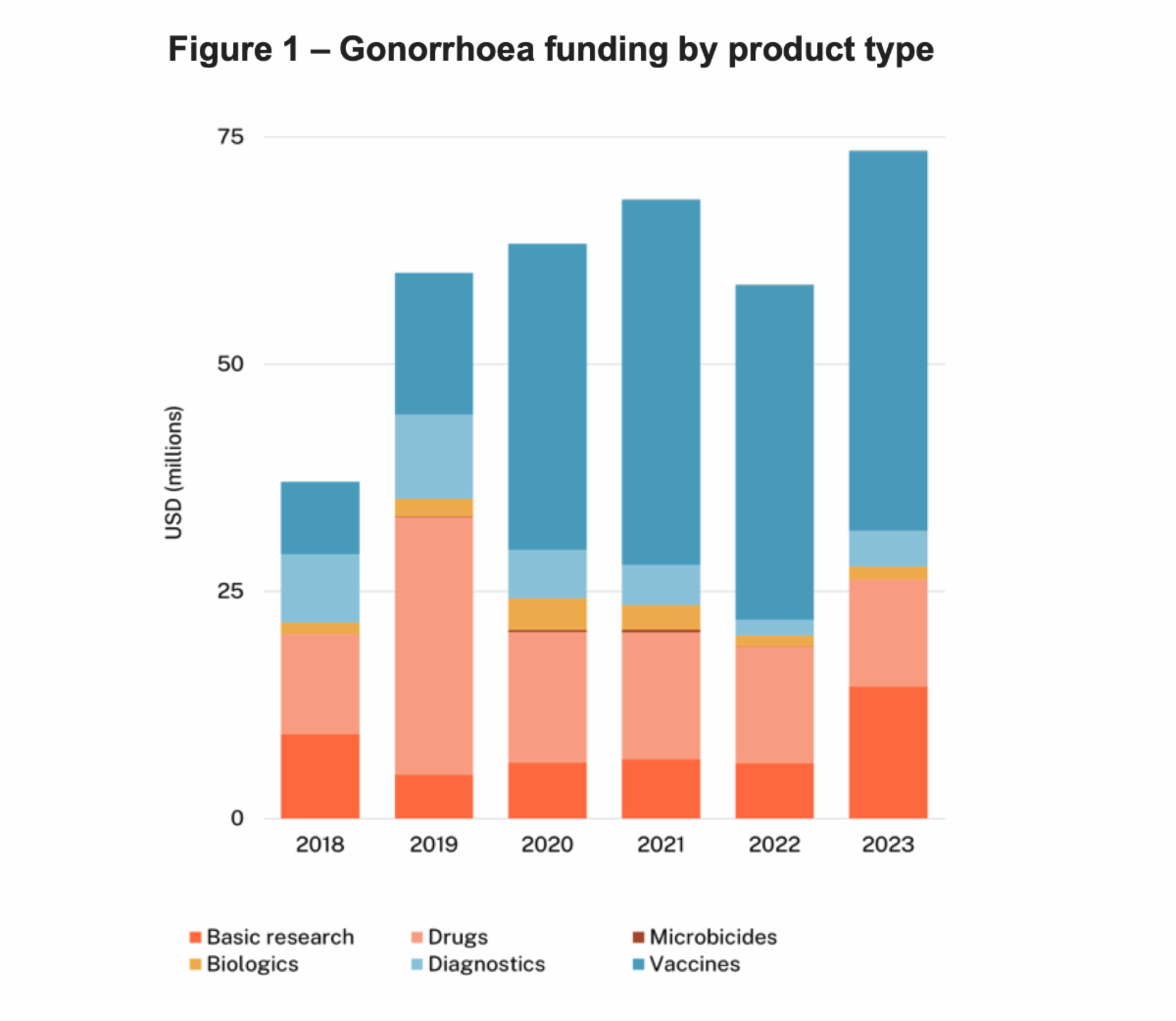
Source: Impact Global Health. Irresistible: Developing new solutions for antimicrobial resistant STIs. “Figure 1 – Gonorrhoea funding by product type.” Q4 2024 / through Q2 2025. Available at: https://cdn.impactglobalhealth.org/media/Irresistible- STIs with AMR risk.pdf (accessed Sept 2025).
Impact Global Health just released a report entitled Irresistible: developing new solutions for antimicrobial resistant STIs. (great title too!) Though morbidity and mortality of gonorrhoea, trichomoniasis, and Mycoplasma genitalium may not be as significant as those observed in HIV or tuberculosis, these three STIs have become considerable victims and drivers of the AMR crisis. This report sought to understand the funding provided to research and development of new drugs, vaccines, and diagnostics as well as the resulting pipeline.
Some key messages from the report include:
- Since 2018, more than $400m has been invested in AMR-risk STI R&D, with 97% of it focused on gonorrhoea.
- Though the antimicrobial drugs pipeline is rich, rapid and affordable diagnostics available are limited. Funding for diagnostics was limited each year compared to basic research, drugs, and vaccines.
- Incentives and innovative funding models are urgently needed to support ‘insurance policy’ antimicrobials that may not be widely used but are essential for future preparedness.
Article Spotlight
Non-Antibiotic Drugs Found to Impact AMR Development in E. coli

A recent article in Nature Antimicrobials and Resistance looked at a variety of commonly used non-antibiotic medications to understand any role in enhancing ciprofloxacin-induced mutagenesis in E. coli. Researchers found that two very commonly used medications that are often provided alongside antibiotics for bacterial infections, ibuprofen and acetaminophen, significantly increased mutation frequency and conferred high-level ciprofloxacin resistance. This study highlights the need to not only accurately prescribe appropriate antibiotics to prevent AMR, but also carefully consider medicine combinations. Additional research on the effects and risks of multiple medications will be critical.
A systematic review and meta-analysis published in the African Journal of Laboratory Medicine identified the emergence of multidrug resistance in febrile neutropenia in Africa. This review further highlights the need for stronger AMR surveillance systems and better antibiotic stewardship.
In Case You Missed It
The World Economic Forum has written the 2025 Davos Compact on AMR in an effort to further galvanize the community and garner political will to take action on AMR. The ambitious goal of the compact is to unlock sustainable and synergistic financing from both public and private sources to reduce the global deaths associated with AMR, saving more than 100 million lives by 2050. An invitation to sign this compact can be found here.
The Center for Global Development have launched an interactive web-based tool to estimate the global and national costs and value of action/inaction against AMR through 2050. A webpage discussing the tool can be found here. This work was based on a report published in 2024.
Don’t Miss
The Centre for Cellular and Molecular Platforms (C-CAMP) and the UK’s Global AMR Innovation Fund (GAMRIF) have launched a new research call to develop solutions addressing AMR in the environment. See here for more. The application deadline is 26 September 2025.
The African Society for Laboratory Medicine is hosting a Special Convention on Diagnostics that will be focused on Accelerating Diagnostic Innovation and Collaboration to Combat AMR and Advance Health Security in Africa in Nairobi, Kenya from 25-27 November 2025. A call for abstracts is now open until 30 September 2025. See here for abstract guidelines.
The Global AMR Innovators Conference (GAMRIC) – previously the ESCMID-ASM Joint Conference on Drug Development for AMR – will be held 1 – 3 Oct 2025 in London, UK. See here for initial details. Registration opened on 5 May.
ICARe (Interdisciplinary Course on Antibiotics and Resistance) will be held 11-19 October 2025 in Annecy, France. See here for details. Applications will open in March.
IDWeek 2025, the annual meeting of the Infectious Diseases Society of America will be held 19-22 October 2025 in Georgia, USA. See here for details.
ASM Global Research Symposium on the One Health Approach to Antimicrobial Resistance (AMR), hosted in partnership with the Centre for Infectious Disease Research (CIDR) at the Indian Institute of Science (IISc) will be held 29-31 Oct 2025. See here for details.
The journal Antibiotics is planning for a special issue entitled, “Antibiotics: Utilization, Resistance, and Infection Prevention”. The editors are inviting submissions for this special issue that addresses various aspects of AMR, including its mechanisms, transmission dynamics, and global impact. Manuscript submissions are due 31 October 2025. Please see here for more information.
World Antibiotic Awareness Week (WAAW) will be held 18-24 November 2025. This year’s theme is “Act Now: Protect Our Present, Secure Our Future”. As events are organized, details will be shared in upcoming newsletters. See an initial website from the WHO here as well as a campaign guide and materials.
The 10th AMR Conference 2026 will be held 3-4 March 2026 in Basel, Switzerland. Once available, details will be here.
2026 Gordon Research Conference (GRC), Antibacterials of Tomorrow to Combat the Global Threat of Antimicrobial Resistance, will be held 8-13 March 2026 in Tuscany, Italy. See here for more details.
ESCMID Global 2026, the annual meeting of the European Society for Clinical Microbiology and Infectious Diseases, will be held 17-21 April 2026 in Munich, Germany. See here for more.
What’s Next
As new tools are under development, all elements of AMR should be considered. Diagnostics, in particular, require prioritization to effectively manage and reduce the AMR crisis by supporting clinicians to more accurately prescribe antibiotics. Further, research and funding to better understand polypharmacy is ever more critical as global populations age.
Creating AMR Awareness
The GHCPD platform presents research and innovations in diagnostics and health services, aligning them with real-world scenarios and practical applications.